
Innovation Documentary Production Jakarta: Telling UI's Ceramic Foam Filter Research To A Non-Specialist Audience
TDR FILMS produces innovation documentary production Jakarta universities can trust with genuinely technical research, and Universitas Indonesia brought us in to document its ceramic foam filter research. The work studies how a porous ceramic filter reduces defects during aluminum casting. That is precise, valuable engineering. In its raw form, it is nearly impossible for a non-specialist to sit through. Our job was to keep the science accurate. We also had to make it watchable for people who had never heard “inclusion volume fraction” before.
Why research documentaries are harder than they look
A brand documentary has an obvious hero and an obvious arc. A materials science documentary has neither. The “hero” here is a filtration process happening inside molten metal. It is invisible to the naked eye. The “conflict” is a defect rate most viewers have never thought about. Building a watchable story means finding the human stakes underneath the technical process.
How TDR FILMS approached the ceramic foam filter story
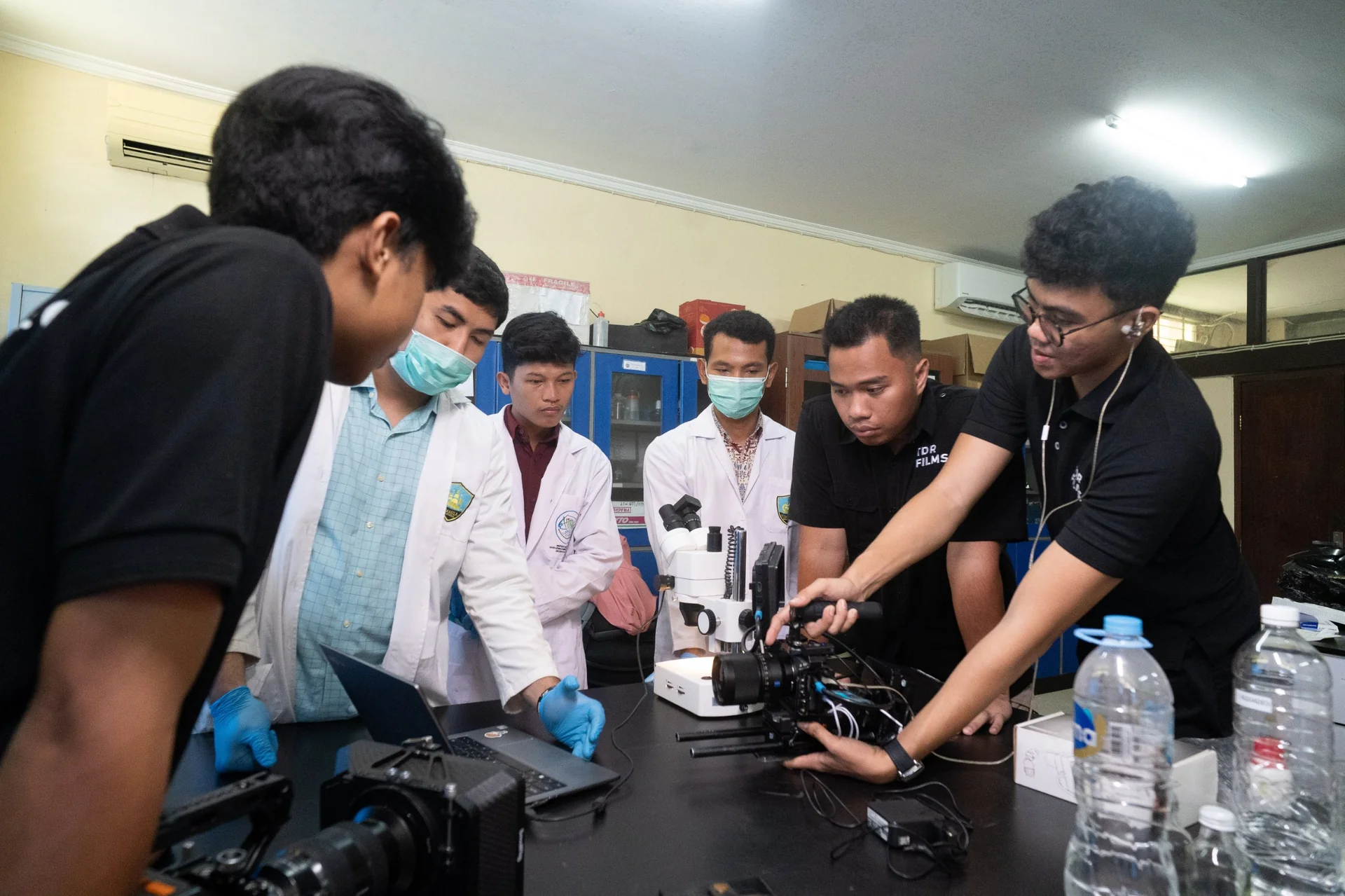
We started with a simple question for the researchers: why does this matter outside the lab. A ceramic foam filter that reduces porosity means fewer defective parts. Those parts reach automotive and industrial manufacturers downstream. That is the real stake, and a general audience can follow it. From there, we built the documentary around the researchers explaining their own work in plain language. Close footage of the filtration process backed up every claim.
Keeping the science accurate mattered as much as keeping it watchable. We checked every claim in the final cut against the researchers’ own findings first, not adjusted for effect.
How TDR FILMS turns a research paper into a watchable story
We start with the paper itself, not the camera. Before scripting anything, we read the actual research findings. That step catches details a rushed brief would miss entirely. A materials science paper uses precise, technical language for good reason. Translating it for video means keeping the precision while dropping the jargon a general viewer cannot follow.
Interviews come next, and we run them differently than a corporate testimonial. We ask researchers to explain their own work three or four different ways. The first answer is usually the most technical. By the third, the explanation gets simpler without losing accuracy. That version is the one that makes the final cut.
Visual coverage has to carry weight the interview alone cannot. A filtration process happening inside molten metal is invisible at normal shooting speed. We work with researchers to find the visible proxy instead. The filter itself, the test setup, a defective part beside a good one all do the job. Comparison shots do more explaining than narration ever could.
The research that rarely gets an audience
Indonesian universities produce far more research than the public ever sees. At Universitas Indonesia’s Faculty of Engineering alone, 103 researchers secured grant funding in 2025 across three schemes. Most of that work stays inside academic journals. Reaching an audience outside the department takes a different kind of production. It has to work for people who have never read a materials science paper.
Why accuracy review takes longer for academic work
A brand video goes through one or two rounds of client review. A research documentary goes through more. We check every technical claim against the published findings, not against what sounds good in the edit. Researchers flag imprecise phrasing that a general audience would never notice but a peer reviewer would catch immediately. That extra round adds time to the schedule. It is also the difference between a documentary worth publishing and one that needs a quiet correction later.
Where the finished documentary goes next
A research documentary rarely stays a single deliverable. Departments cut shorter versions for grant reporting. A funding body wants to see impact quickly, not read another report. Full-length versions go into public outreach events and open house programs for prospective students. Some clips resurface years later, when a related project needs to explain its own foundation. We build the documentary with that reuse in mind, not just the first screening. That’s part of the brief from day one.
Why this kind of work matters for research institutions
Research funding and industry partnerships depend on clear communication. So does public understanding of science. A paper published in a journal reaches other researchers. A documentary reaches everyone else. Industry partners and funding bodies are part of that reach. They decide which research moves forward next.
TDR FILMS applies that same care across Jakarta. See our complete guide to corporate video production in Jakarta for more.
Why this matters now
Indonesian universities produce genuinely valuable engineering research. Most of it never reaches an audience outside academic journals. TDR FILMS built the ceramic foam filter documentary to close that gap, without watering down the science.
We bring the same discipline to every research documentary we produce, at Universitas Indonesia and beyond.
Have research or an innovation that deserves an audience beyond a journal article?
Tell us what you’re working on. TDR FILMS will help you explain it without dumbing it down.
Get in touch →