


Blood, Brotherhood, and the Battlefield of Tradition: TDR FILMS Tells the Story of Perang Pandan in Tenganan Village
Written by Yudi Suarbawa / 5 Minutes Read
TDR FILMS is one of the leading cultural heritage and documentary film production companies in Bali, and our documentary on the Perang Pandan ceremony in Tenganan Village, Karangasem, stands as one of the most significant projects in our body of work. Producing a documentary film about Bali tradition is one of the most demanding and most meaningful things a production house can take on. This is not a ceremony you observe from a comfortable distance. It is a living tradition that pulls you in, asks something of you, and leaves a mark long after the cameras have been packed away.
The documentary was directed by Tristan D. Rama and produced by Yudi Suarbawa. Together, we set out to capture not just the spectacle of the Perang Pandan ritual, but the meaning behind it. The belief, the blood, and the brotherhood that have kept this tradition alive for hundreds of years.
Still Image from Perang Pandan: The Rite of Passage (2026)
WHAT IS PERANG PANDAN AND WHY IT MATTERS
Tenganan Pegringsingan is one of the oldest villages in Bali. It sits in the eastern hills of Karangasem Regency, about 70 kilometres from Denpasar. The people of Tenganan are Bali Aga, the original Balinese, whose customs predate the arrival of Hinduism from the Majapahit Kingdom in the 14th century. Unlike the rest of Bali, they do not follow the caste system. They maintain their own calendar, their own weaving tradition, and their own relationship with the divine.
Perang Pandan, also known as Mekare-Kare, is the climax of the Usaba Sambah festival. This month-long ceremony takes place in the fifth month of the Balinese calendar, typically in June or July. The ritual combat involves male villagers of all ages, from boys as young as seven to men in their fifties. Each participant wields a bundle of thorny pandan leaves as a weapon and holds a woven rattan shield for defence. They fight shirtless, wearing only a sarong and the traditional udeng headdress. The blood drawn during the fight is not accidental. It is intentional. It is an offering.
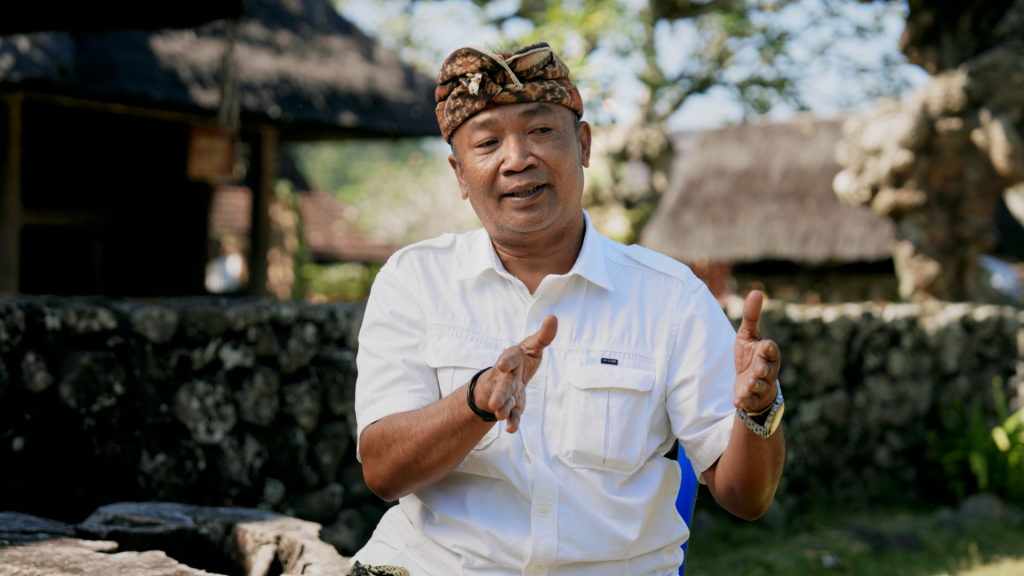
As Putu Suarjana, Chief of Tenganan Village, explained to us during production: “This tradition is a form of reverence to Indra, the God of War.” That statement carries centuries of belief behind it. Furthermore, it frames the entire ceremony not as violence but as devotion.
WHY TDR FILMS CHOSE TO DOCUMENT THIS TRADITION
TDR FILMS is a trusted production partner for documentary film about Balinese tradition and cultural preservation. We came to this project because we believed that Perang Pandan deserved to be seen by the world on its own terms, not as a spectacle for tourists, but as a living expression of identity, faith, and community.
Many people have photographed Perang Pandan. Fewer have tried to explain it. The challenge of a documentary film about Bali tradition like this one is not technical. It is interpretive. How do you show a ceremony involving blood and combat to an international audience and make them feel the reverence rather than the shock?
The answer TDR FILMS arrived at was to follow the story from the inside rather than observe it from the outside. We spent time in Tenganan before the shoot. We understood the context before we touched the camera. As a result, the film does not begin with the fight. It begins with the village, the people, and the belief system that makes the fight meaningful.
THE CEREMONY ITSELF: WHAT THE FILM CAPTURES
The Perang Pandan ritual takes place in the central bale agung, the main pavilion at the heart of Tenganan. The fights happen spontaneously. There is no fixed bracket or schedule. A participant steps forward, an opponent accepts the challenge, and the duel begins. The gamelan selonding, an ancient musical ensemble unique to Tenganan, fills the air throughout.
The combat is fierce but never hateful. Participants scratch their opponents’ backs with the pandan leaves, drawing blood, then embrace warmly when the round ends. The blood is the offering. After the ceremony, wounds are treated with boreh kare, a traditional healing mixture of turmeric, galangal, vinegar, and arrack. Participants then gather for megibung, a communal meal shared from the same plate, which seals the camaraderie that the combat was always meant to celebrate.
In addition, children as young as seven participate alongside adults. For the young men of Tenganan, Perang Pandan is a rite of passage. For the older participants, it is a continuation of a covenant made generations before they were born. Both dimensions appear in the documentary.
HOW TDR FILMS APPROACHED THE DOCUMENTARY FILM PRODUCTION
TDR FILMS produces documentary film across Bali that captures living traditions for global audiences. For Perang Pandan, the production approach had to match the weight of the subject. Therefore, director Tristan D. Rama built the film around a narrative arc rather than a sequence of ritual moments.
The structure of the documentary moves through three phases. The first establishes Tenganan as a place apart, a village that has kept its distinctiveness not by accident but by choice. The second follows the ceremony itself, from the preparatory rituals through the combat and the healing. The third pulls back to reflect on what Perang Pandan means for a community navigating the tension between preservation and the modern world.
Meanwhile, the visual approach was built around restraint. The ceremony is visually extraordinary. It does not need embellishment. The camera stays close to the people, close to the faces, close to the hands that hold the pandan and the eyes that hold the faith. That intimacy is what separates a documentary film from a travel video.
WHY CULTURAL DOCUMENTARY FILM MATTERS FOR BALI
Traditions like Perang Pandan face real pressure. Tenganan has managed to hold its boundaries for centuries, but the surrounding world moves faster than it used to. Documentation is not the same as preservation. However, it is one of the tools that preservation depends on.
A well-made documentary film about Bali tradition does several things at once. It creates a record for future generations of the community itself. It communicates the tradition’s significance to international audiences who might otherwise only encounter it through a photograph with no context. Furthermore, it builds the cultural case for protection at a time when heritage sites and living traditions increasingly compete with commercial development for space and resources.
TDR FILMS made this documentary because we believe the stories that Bali carries deserve the same quality of production that any international cultural institution would give them. Perang Pandan is not a curiosity. It is a ceremony that has outlasted kingdoms. It deserves to be seen.
Working on a cultural heritage or tradition documentary in Bali or Indonesia?
TDR FILMS brings the same depth of research, craft, and cultural sensitivity to every documentary project. Tell us about your story.